Multimodal emotion recognition
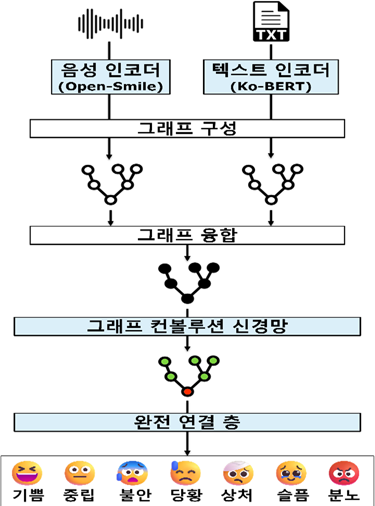
Built an older-adult speech dataset and evaluated graph-based fusion of speech and text for emotion recognition.
01 / RESEARCH DETAILOlder-adult speech: acquisition and transcription effects
- Challenge
- Older-adult speech and transcription errors can alter text-based emotion classification.
- Approach
- Compared speech, original text and transcribed text using the same subject-independent split of fixed-sentence utterances.
- Contribution
- Designed IRB and emotion-elicitation protocols, co-developed models and supported data construction and technology transfer.
View full-size figure
| Acquisition / evaluation | Experimental conditions |
|---|---|
| Older-adult experiment | 24 participants, ages 66–81 |
| Utterances | 7 emotions, 1,512 utterances |
| Evaluation / outputs | Subject-independent 4-fold / Best Poster Award |
Evaluation conditions and scopeThe experiment involved 24 participants aged 66 to 81, seven emotions and 1,512 utterances. Transcription reduced weighted F1; adding speech did not recover this loss under the tested condition.
02 / RESEARCH DETAILEmotionHeart: dialogue graphs and missing modalities
- Challenge
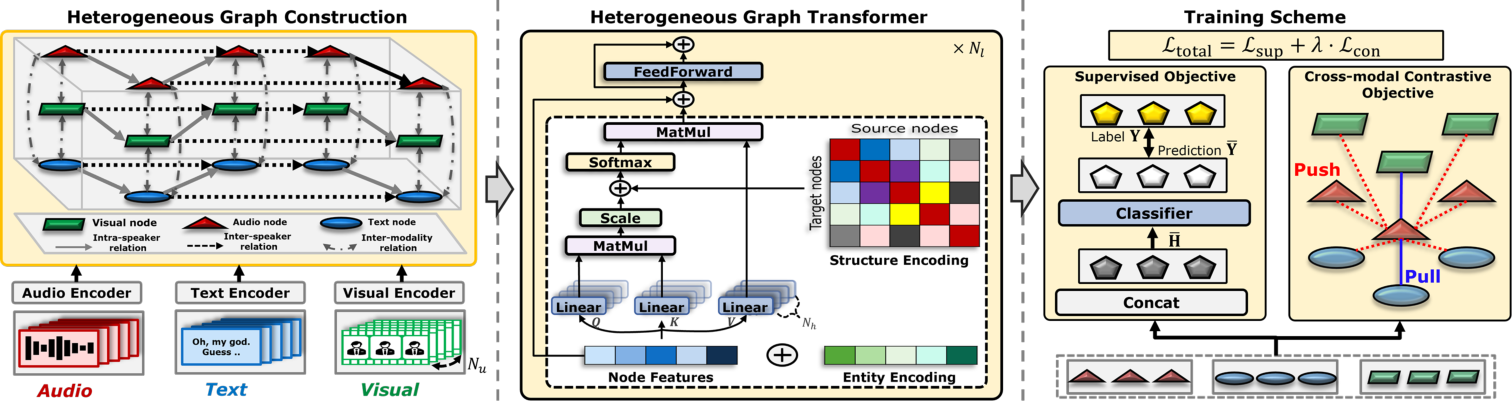
- The model must represent speaker relationships and modality differences while retaining context when an input is missing.
- Approach
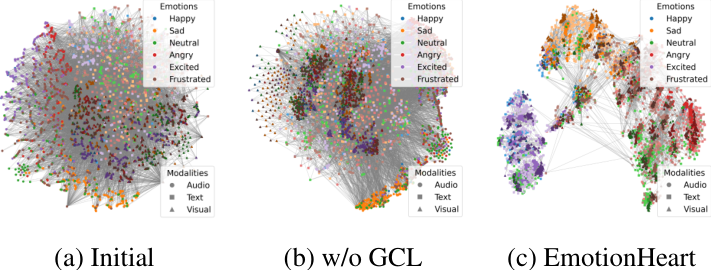
- Encoded within-speaker, between-speaker and cross-modal relations, then aligned modalities with an augmentation-free contrastive objective.
- Contribution
- Designed the heterogeneous graph and alignment loss and evaluated missing modalities. First author, ICASSP 2026.
View full-size figure
View full-size figure
| Evaluation setting | Baseline | Proposed model |
|---|---|---|
| IEMOCAP, all inputs | 68.99 | 73.13 |
| MELD, all inputs | 66.75 | 68.99 |
| IEMOCAP, audio only | 54.09 | 60.26 |
Evaluation conditions and scopeWeighted F1, averaged over 10 random splits. The full-input baseline is Transformer; the audio-only baseline is GRACE. IEMOCAP: 73.13 with all inputs and 60.26 with audio only.