EEG graph learning and compact decoding
Graph contrastive learning and compact temporal models were developed for EEG emotion recognition and motor-imagery decoding.
01 / RESEARCH DETAILASGCRL: adaptive graphs and contrastive learning
- Challenge
- Incorrect connections in fixed similarity graphs can propagate errors when labels are scarce.
- Approach
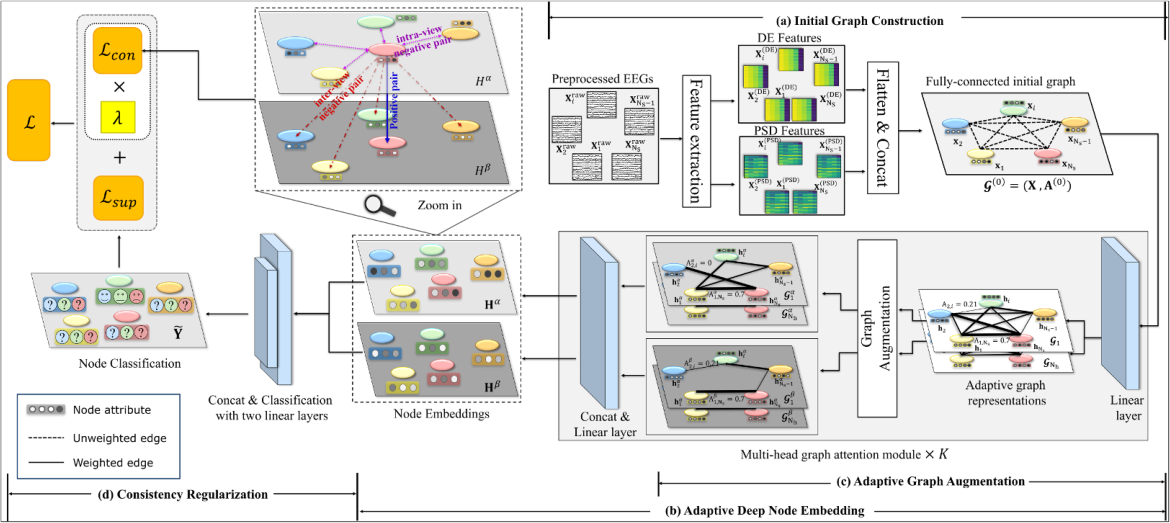
- Updated connections with learned representations and used adaptive augmentation to preserve class relationships during contrastive learning.
- Contribution
- Designed the method, implemented the model, conducted ablations and wrote the first-author KBS 2026 paper as a follow-up to SGCL.
View full-size figure
View full-size figure
View full-size figure
| SEED-IV Case 1 | Accuracy |
|---|---|
| Static GCN | 75.75 ± 8.95% |
| ASGCRL | 87.31 ± 3.84% |
| Matched-protocol difference | +11.56%p |
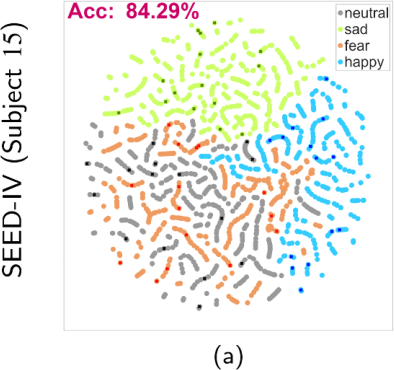
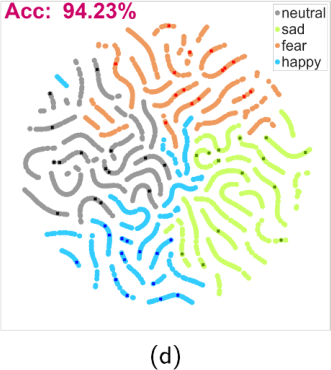
Evaluation conditions and scopeSEED-IV Case 1, 2.4% labels, subject-wise transductive evaluation. Embedding example: subject 15.
02 / RESEARCH DETAILSimNeXt-EEG: compact temporal attention
- Challenge
- A small motor-imagery model must capture multiple temporal scales and suppress noise.
- Approach
- Extracted temporal features with multiple kernels and recalibrated time points using parameter-free SimAM attention.
- Contribution
- Designed the model, measured classification accuracy and CPU latency, and conducted ablations for the first-author IEEE SPL 2026 paper.
| Stage | Operation / output |
|---|---|
| MSTF | Temporal kernels 32, 80 / 8 channels |
| STE | Spatial separable convolution + SimAM |
| STR | Temporal separable convolution + SimAM |
| Classification | Flatten, Linear / 4 classes |
| Model | Parameters | CPU latency |
|---|---|---|
| EEGNet | 3.44K | 0.79 ms |
| MSVTNet | 75.49K | 3.78 ms |
| SimNeXt | 1.84K | 1.46 ms |
Evaluation conditions and scopeBCI Competition IV 2a, session-independent accuracy: 70.81 ± 0.49%. Complexity: 1.84K parameters and 20.69 MFLOPs. Latency: 1.46 ms on a desktop CPU, batch size 1; not a wearable-device measurement.