NeuroSync
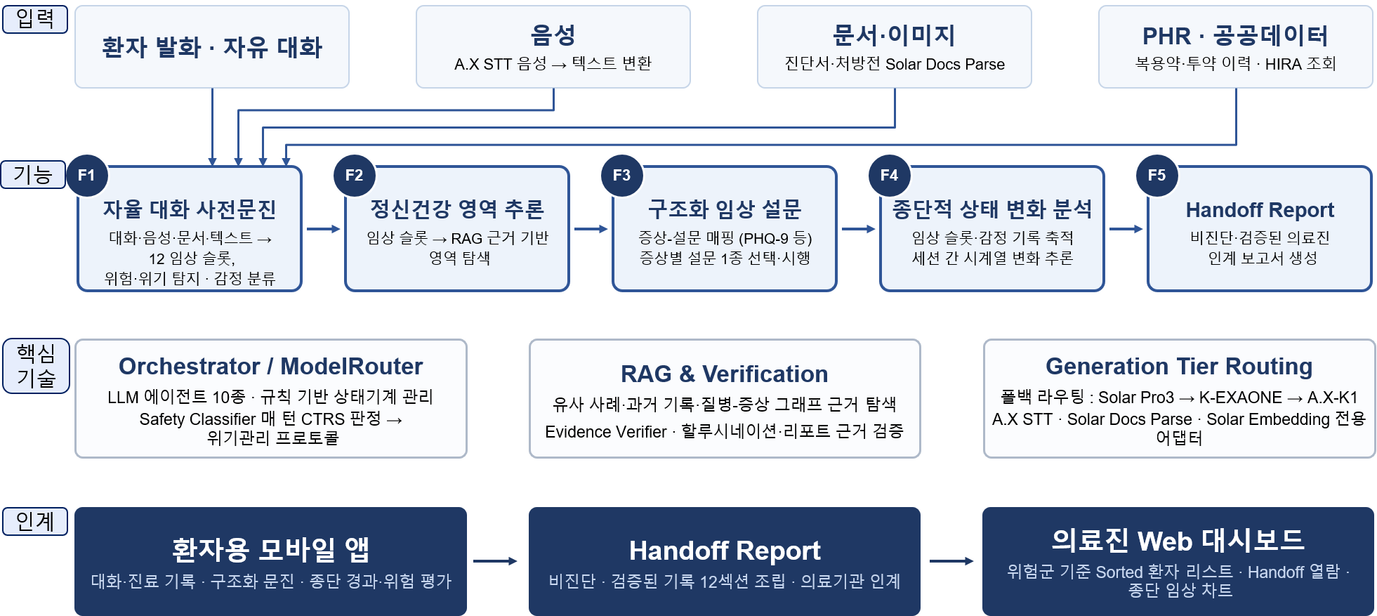
Combined Korean LLMs with evidence verification to turn intake conversations into structured clinician handoff records.
01 / RESEARCH DETAILNeuroSync: intake, retrieval and clinician handoff
- Challenge
- Free dialogue must populate clinical slots without allowing unsupported values into the handoff record.
- Approach
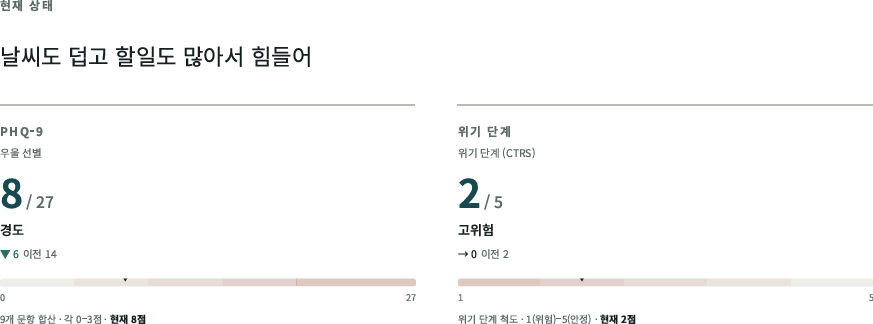
- A rule-based state machine runs 10 specialist agents. Scales use deterministic scoring, and final records undergo source and evidence checks.
- Contribution
- Implemented orchestration, RAG and verification logic and integrated the patient app, clinician interface and backend.
View full-size figure
View full-size figure
| Component | Implementation scope |
|---|---|
| Korean models | Solar Pro 3, K-EXAONE, A.X K1 |
| Retrieval corpus | 1,248 clinical cases, 1,789 QA entries |
| Services | FastAPI, PostgreSQL, Expo, Next.js |
Evaluation conditions and scopeAI Champion intake prototype for preparing clinician handoff records; it does not make diagnoses.
02 / RESEARCH DETAILNeuroSync: output reliability and inference cost
- Verification results
- Verification blocked 337 unsupported candidates before final output and improved slot coverage and scale assignment.
- Remaining issue
- The pre-filter unsupported-candidate ratio rose from 46.4% to 55.2%, exposing limitations at the generation stage despite final-output verification.
- Next steps
- Further work concerns reducing calls and tokens and obtaining specialist assessment and clinical proof-of-concept evidence.
| Metric | Single backbone | NeuroSync |
|---|---|---|
| Tokens per session | 30,514 | 125,933 |
| Sessions with unsupported outputs | 54.2% | 0% |
| Full evaluation | 8 personas | 384 sessions |
Evaluation conditions and scopeEight synthetic personas, 384 sessions in total; 144 sessions in the direct comparison with a single-backbone baseline.